

No, we’re not talking about a new type of breakfast cereal. We’re talking industrial measurement.
Many of us have seen hardware with outputs labelled 4-20mA or current loop output but might not have used them. However, current loops are an effective means of transmitting data from a sensor or between systems, while ensuring data integrity. In this post we will take a very brief look at current loops and why they are useful.
Current loops originated as a byproduct of pneumatic control systems. Air pressure in the system was modulated between two set levels to signal on/off (digital) or somewhere in between (analogue). As systems grew larger and more complex, it was realised that running large piping networks and trying to maintain it all at pressure was not practical. Wires started to be used instead.
The principles between pneumatic and electrical signaling are the same. Create a loop containing something to energise the loop (power supply), something to moderate that energy (transmitter), and something to receive it (receiver). Many current loops use a voltage of +24V to power the current loop and we will look at why shortly. The transmitter might be a sensor of some type, like a temperature transducer, which will change the flow of current depending on what it measures. The transducer is selected (or configured) for the range of expected temperatures and the current loop type we are using (4-20mA/0-100mA/etc). Lastly, the receiver is essentially a resistor which is placed in the loop and will create a potential difference across it depending on the loop current. We measure this voltage and, through a calibration, can determine the temperature.
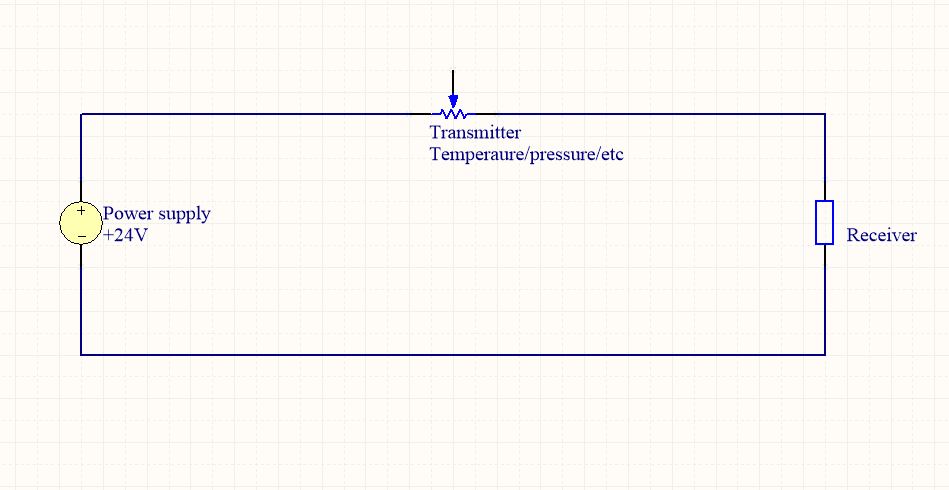
Buy why?
At this point you might be thinking that this seems a bit of a weird way of measuring system parameters, especially in 2021. We have to consider a couple of points before we rush to judgement.
1.) As mentioned, electrical current loops were a direct translation from pneumatic control into electrical control. As such techniques stayed the same. This was a time before analogue-to-digital conversion and complicated modern controllers to perform acquisition and analysis.
2.) Noise immunity. One of the big advantages of the current loop is the ability to transmit analogue data over reasonably long distances without noise issues. The main reason for this is the typically very large source impedance of the transmitter in comparison with that of the receiver. The results in tiny fluctuations of receiver voltage for even large variations of power supply voltage, or noise voltage induced on the loop – equation below.

Where;
- Verror = Resultant variation in measured voltage at the receiver,
- Vnoise = Unwanted voltage variation at power supply ,
- Rrec = Receiver input resistance – 250R is a typical value,
- Rtrans = Transmitter output resistance – typically in the MOhm range,
- Rwire = Parasitic wire resistance – depends on wire length mOhm/m typically.
Future Proofing
Now we can see how current loops work and why they are very effective in what they do. However, this is 2021 and ,although our systems still work, we would like to take advantage of new technology like remote monitoring, or IOT, or even use data from our existing sensors to expand our system. Is this possible?
Yes, absolutely. One of the great thing about current loops is they don’t have to have just one receiver in the loop. In the image below we have placed a second receiver in series with the existing one, the DB106B. While this does not affect the existing receiver, which for example might be a PLC input, it does allow us to do some more advanced data monitoring of our existing system without large modifications.
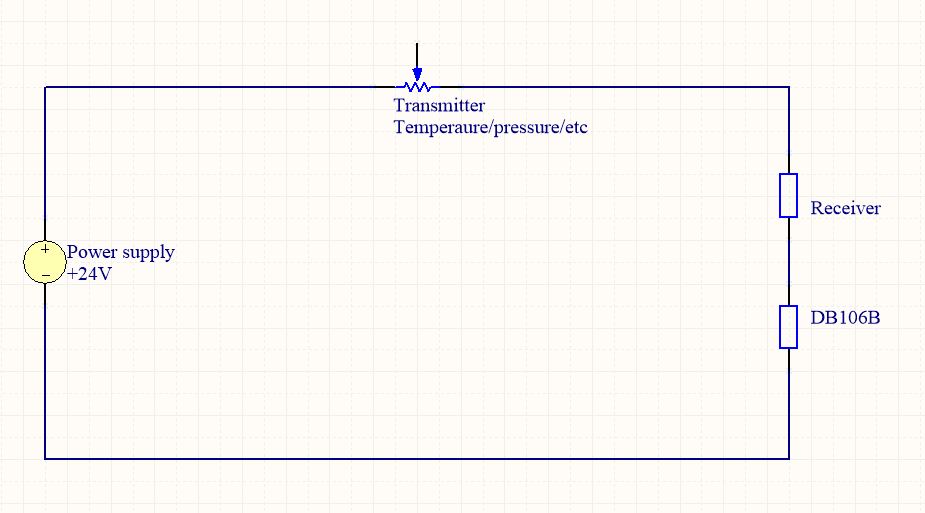
DB106B & DB106C 2-Channel Current Loop Data Loggers
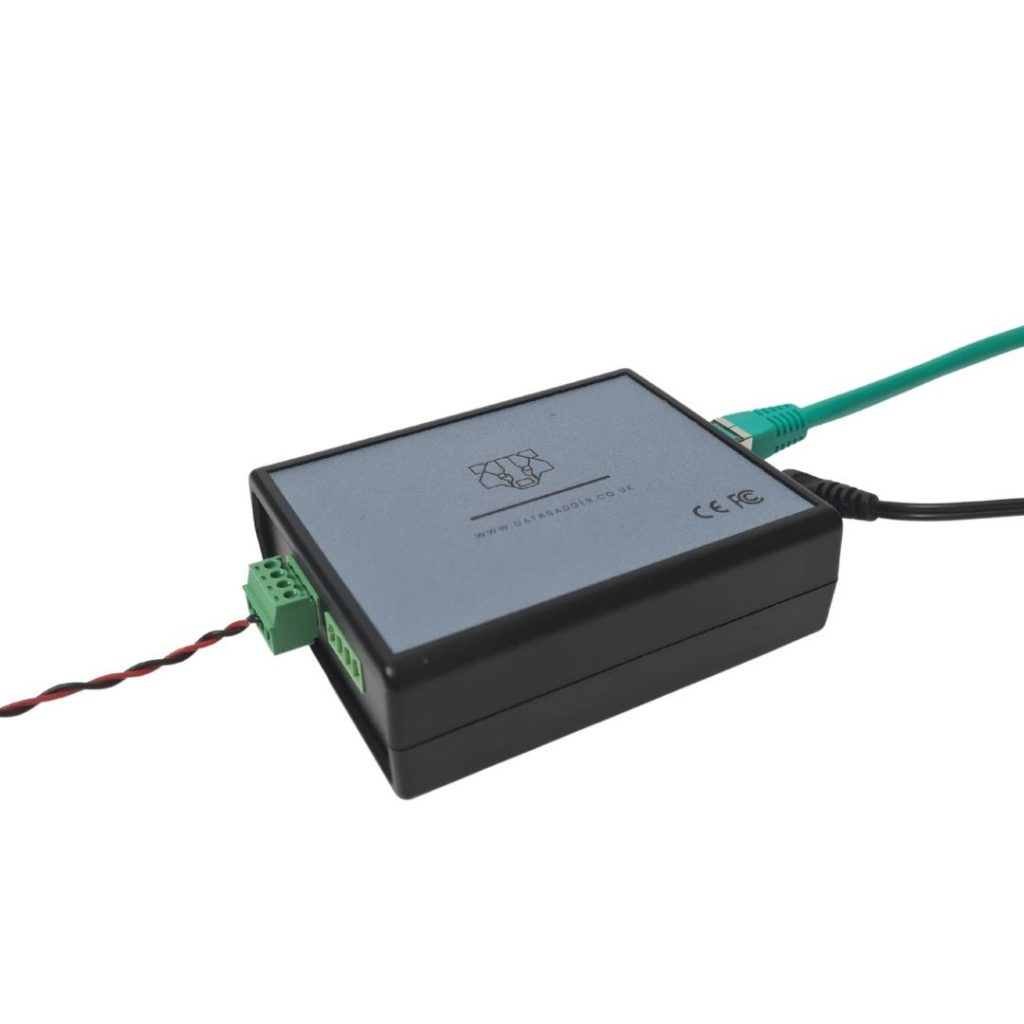
DataBadger’s new data loggers allow monitoring of +/-0-20mA (DB106B) and +/-0-100mA (DB106C) over a network or even the internet. This allows the modernisation of existing current loops, without compromising the advantages of these systems. For those looking to expand existing control systems, DataBadger’s systems offer an easy way of doing so.
These devices have an internal update rate of 625 Hz which is accessed via Ethernet using the BadgerView application. There is also an API available for those who wish to develop their own applications. With a resolution of 0.005 mA (DB106A) and accuracy of +/-0.1% you can be sure of high performance monitoring fit for the future.
If you would like to learn more about our range of current loop systems, please head to our shop page and check out our datasheets. You can also get in touch to ask any questions via our contact page. DataBadger also offer a bespoke product tailoring service so feel free to approach us with your requirements.